
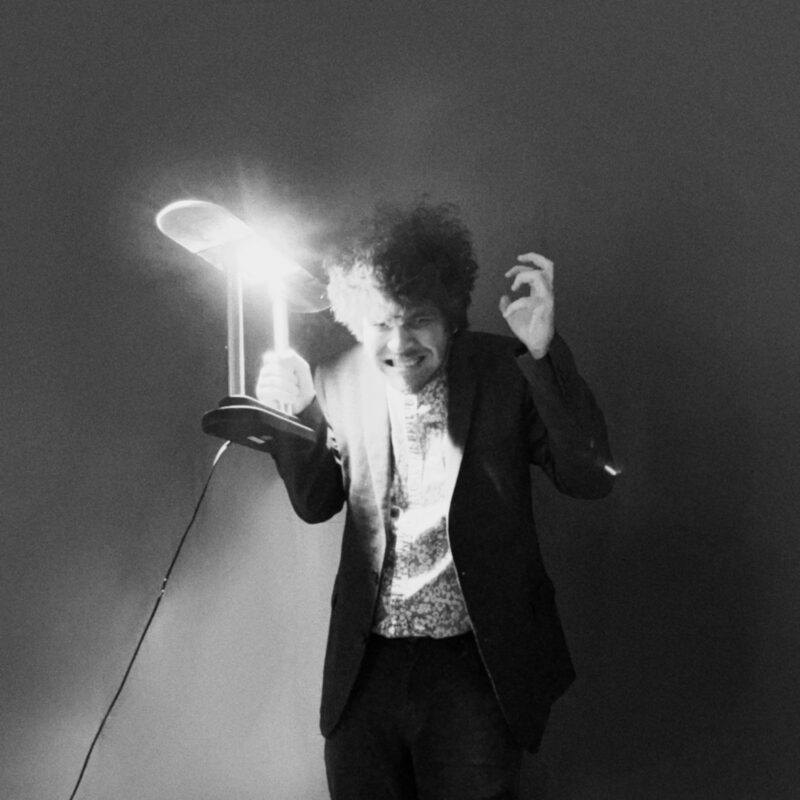
Monsieur Herr returns with The Distortion Years, an album that approaches pop music, artistic convention and creative excess with equal parts irony, self-awareness and deliberate disorder.
The project arrives with a knowingly grand title and an even more knowingly exaggerated attitude towards its own existence. Monsieur Herr seems fully aware of the absurdity of adding another album to an already overcrowded musical world, yet The Distortion Years turns that contradiction into part of its creative purpose. Rather than pretending to have a definitive answer to what art should be, the project repeatedly questions why those boundaries exist in the first place.
The album continues the philosophy established on Everything’s Great, where rough edges, strange ideas, and abrasive sounds are not automatically treated as problems requiring correction. Monsieur Herr is interested in knowing when to polish something and when leaving it imperfect creates the more interesting result.
That approach gives The Distortion Years an intentionally unstable relationship with form. Songs move towards familiar structures before twisting away from them, while lyrical ideas frequently collide with humour, absurdity and darker reflections. There is a sense that the album is constantly examining its own construction while simultaneously refusing to behave.
“Boogie Wonderland” immediately captures that mentality. The song’s references to the “Brain Exchange,” “Self Removal,” “Guy Exploder” and “Me Obliteration” create an exaggerated world where self-consciousness becomes almost physical. The absurdity is intentional, but underneath the humour is a recurring fascination with identity, insecurity and the desire to escape one’s own limitations.
The song also draws directly from Yellow Magic Orchestra’s “Stairs,” specifically the Winter Live 1981 version. Monsieur Herr describes the main synthesizer riff as a reworked mutation of that material, turning an existing musical idea into something deliberately transformed. That idea of mutation becomes important across the album, where influence is not hidden but reshaped into something stranger.
“My Halcyon Days” takes a more reflective route. Recorded in only two days after another planned track was abandoned, the song became an examination of repetition, creative embarrassment and the uncomfortable process of making art. Monsieur Herr had recognised that the original song was effectively repeating ideas from “Resource War” and chose to remove it rather than simply reproduce something that had already been done.
That decision becomes part of the song itself. The Distortion Years repeatedly asks whether creating something different actually means creating something new, and whether repetition can ever escape the influence of what came before.
“Periscope” pushes the album into even more surreal territory. Built around underwater and military imagery, the song moves through submarines, torpedoes, surveillance, and communication while maintaining the project’s fascination with absurdity. Its description as an Iran war military propaganda song adds another deliberately exaggerated layer to the concept, with Monsieur Herr’s own dark humour keeping the track from settling into a conventional political or military narrative.
“Nihilism Blusche” is perhaps one of the album’s most revealing moments because its humour gives way to something more personal. Monsieur Herr explores the connection between insecurity, cynicism and ironic detachment, admitting that nihilistic thinking can become attractive when someone is uncertain about their place in the world.
The song also acknowledges the danger of allowing cynicism to become an excuse for cruelty. Beneath the jokes about ageing, personal reinvention and becoming the self-appointed CEO of “This Sort of Thing, LLC” is an admission that self-awareness does not automatically make someone better. Sometimes recognising your own behaviour means confronting uncomfortable truths about yourself.
The title track, “The Distortion Years,” brings many of those ideas together. The song considers environment, personal history, language and the struggle between natural impulses and the desire to move forward. Its central reflection on reconciling those impulses with simply wanting to get out of bed gives the record an unexpectedly vulnerable centre.
Monsieur Herr explains that the song was originally recorded towards the end of the Everything’s Great sessions, but its lyrics were not yet ready. Eventually, it became the centrepiece of this album. That history gives the title track another layer of meaning: the song itself went through a process of revision and transformation before finding its place.
“Former Island” closes the supplied sequence with a different kind of distortion, using the history of the Zuiderzee and the creation of new land as a metaphor for displacement, cultural change and the loss of familiar environments. The imagery of reclaimed land, disappearing traditions and an uncertain relationship with language creates an uneasy final impression.
Across The Distortion Years, Monsieur Herr treats music as both a creative outlet and a place to interrogate ideas. The album is exuberant in its willingness to be strange, but its eccentricity is not without purpose. Beneath the jokes, surreal images, and deliberately pretentious declarations is a serious interest in how people construct identities, how art responds to its surroundings and how difficult it can be to create something without simply repeating what already exists.
There is also an important tension between control and chaos. Monsieur Herr clearly knows what he is doing, yet the project repeatedly creates the impression of an artist allowing ideas to run beyond their expected boundaries. Structures can be distorted, influences can be mutated, and serious observations can sit comfortably beside ridiculous ones.
That may be the real point of The Distortion Years. Rather than presenting another polished answer to what pop music can be, Monsieur Herr embraces the mess of making it. The album recognises that every new piece of art enters a long history of existing ideas, sounds and conventions, then chooses to distort those ingredients rather than pretend they were never there.
In that sense, The Distortion Years is not simply interested in making music. It is interested in questioning the machinery behind making music, the expectations surrounding it and the strange impulse that keeps artists creating even when they are fully aware that everything has already been done before.
And perhaps that is exactly where Monsieur Herr wants the listener to remain: somewhere between sincerity and satire, refinement and roughness, confidence and self-doubt, with the boundaries constantly shifting underneath them.