



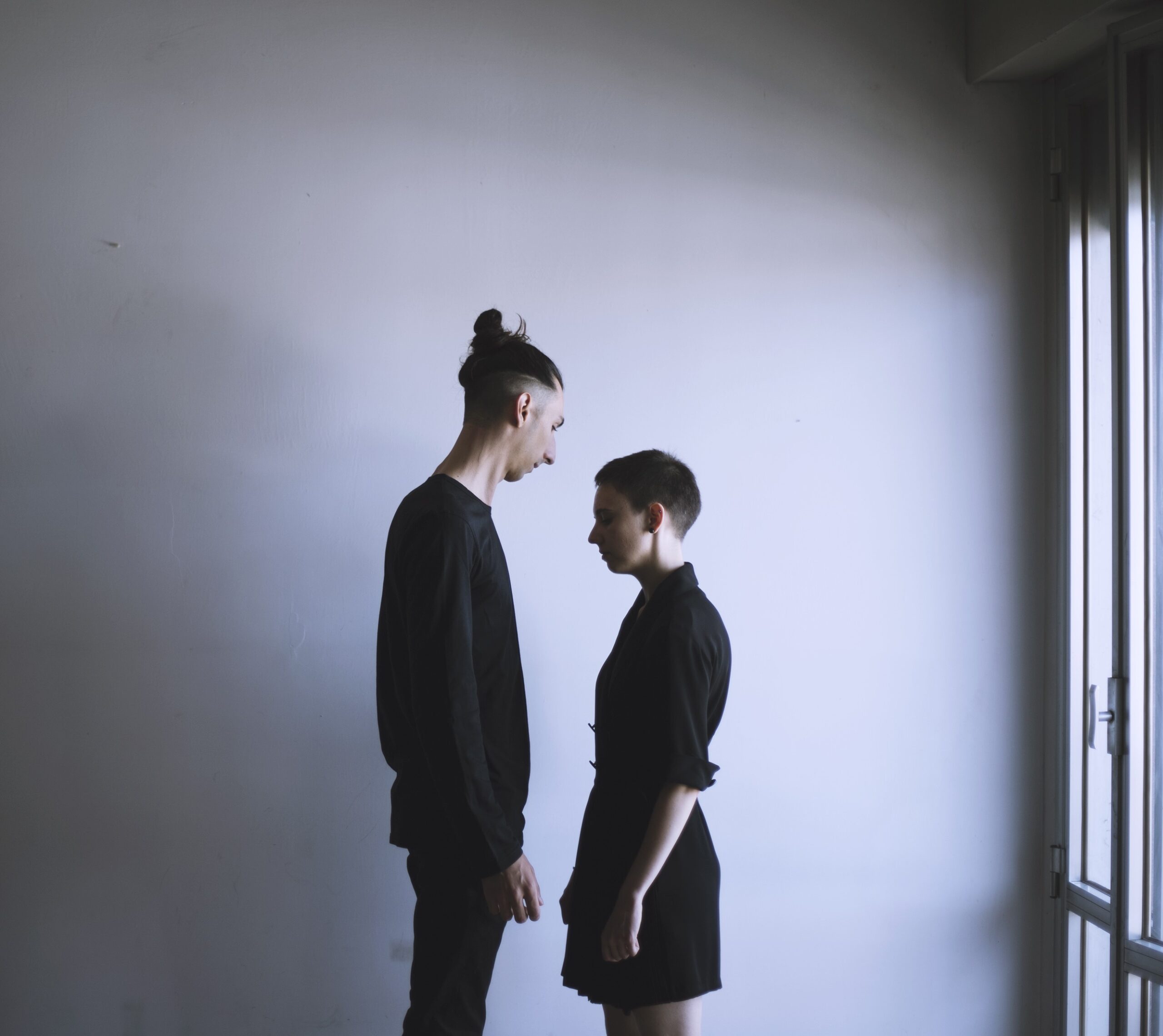
Some collaborations feel planned, others feel inevitable. For Hyperflower, the connection between Lorenzo Setti and Irene Cavazzoni Pederzini sits somewhere in between—born from a chance studio encounter and shaped by a shared fascination with sound, emotion, and the spaces in between.
What began in 2018 as a brief meeting during the mixing of Lorenzo’s debut EP soon evolved into something far more expansive. Drawn together by overlapping musical sensibilities and a mutual curiosity for experimental and atmospheric expression, the two artists found in each other a creative mirror. That instinctive connection would go on to form Hyperflower, a duo that exists in a delicate balance of introspection and innovation.
Their latest single “Hold” captures that essence with striking clarity. Rooted in themes of emotional rupture, healing, and self-embrace, the track unfolds like a quiet internal dialogue—fragile yet immersive, structured yet fluid. Blending elements of alternative, experimental, and pop, Hyperflower crafts a sound that feels both intimate and otherworldly, where repetition becomes meditation, and distortion becomes clarity.
In this conversation, Lorenzo and Irene open up about the origins of their collaboration, the emotional weight behind “Hold,” and the creative philosophies that continue to shape Hyperflower’s evolving sonic universe.
First of all, for readers discovering your music for the first time, who are Hyperflower, and how did the collaboration between Lorenzo and Irene begin?
Lorenzo: Back in 2018, I asked Davide Bombanella to take care of the mixing and mastering of my debut EP “ARMØNIA”, first release under the moniker ATŌMI. Irene happened to be the studio assistant of Davide at that time, and that’s how we met. I remember she was really taken with my EP, and as we talked about our interests, the music and the aesthetics we were most drawn to, we discovered that we were a great source of inspiration to one another. That’s how the idea of embarking on a new musical journey together came about, quite spontaneously.
Your new single “Hold” explores the idea of self-recomposition after emotional rupture. What inspired the story and emotional core behind this track?
Irene: I think the inspiration for ‘Hold’ started with me. I lost a friend during that time – one of those friends you are close with, but not too close, so it was an especially odd grief to deal with. ‘Hold’ came out of that moment, first as a short poem and a simple melody, then as a Hyperflower song. Lorenzo came up with the incredible idea of shaking the time: that really carved out what this re-composition—this healing through melting and stillness—was all about.
The song feels deeply introspective, almost like an internal conversation with oneself. How did you approach translating such a personal emotional state into sound?
Lorenzo: For me, composing music remains one of the most intimate and sincere ways to bring the different parts within me into dialogue. A large part of this process involves setting aside the logical, judgmental part of me that wants to reconcile these parts through a logical, linear dialogue. The key, however, lies in the subconscious, instinctive action that arises from an emotional connection with sound. This is not only an internal dialogue but also a give-and-take relationship with various instruments and/or other musicians. The translation of all these interactions depends on the ability to listen, as if we were simultaneously positioned both inside and outside the process.
“Hold” uses repetition like a mantra, with the same words and melodic elements cycling throughout the track. What drew you to this cyclical structure?
Irene: We were both very interested in repetition, by the concept of something that changes through the sole act of repeating itself (which almost feels paradoxical when you think about it). I remember us talking a lot about The Disintegration Loop by William Basinski, back then. There is also a spiritual quality to repetition—mantras are the perfect example— that we both were drawn to.
The production constantly feels like it’s shifting slightly off the grid, giving the song an unpredictable flow. Was this intentional, and how does that approach reflect the theme of emotional instability or healing?
Lorenzo: The grid is still there, but I really love playing around with it until it fades away. In this track, Irene’s vocals – recorded specifically on the edge of the metrical grid – help to create a flexible sonic effect that both drives and slows down the rhythm of the bass and the main melody. ‘Hold’ was conceived as a ‘metrical mirage’: I see it as getting lost in the reflections of a portion of reality reproduced by a mirror, to the point of merging entirely with that other reality. Every time you pass through the mirror, the rhythm changes: the rhythmic elements remain the same, but their form shifts.
Your music blends alternative, experimental, and pop elements in a very delicate way. How do you strike a balance between accessibility and experimentation?
Irene: As silly as it may sound, it was not fully intentional. We approached this album from a very intuitive place, caring for the clarity of the structure but letting the song define its own nature. I think it’s fair to say that we both come from a musical listening background that features this same quality.
Hyperflower’s aesthetic touches on post-human, retro-digital, and futuristic sounds. What attracts you to these sonic and conceptual themes?
Irene: There is something about science fiction—and the sounds associated with it—that we’ve always been drawn to. Science fiction today, if you think about it, is paradoxically speaking about a future that now feels vintage. And yet, it still holds this ever-present sense of escapism and abstraction that we both found fascinating.
Atmospheric textures play a huge role in the song. How do you approach building these soundscapes in the studio?
Lorenzo: There was a good amount of post production on the vocals, many samples were: cropped, stretched or looped / granulated and the vocals were going through several efx played by me in real-time while Irene was recording or in post-production. We were used to sending stem tracks and additional recordings back and forth, to be gradually defined by me into a structure. During this process several parts were not kept but manipulated again to become background sounds with the aim to create a tangible almost tactile dimension, as all this was actually happening next to you but you were with us somewhere in a parallel reality.
Since Hyperflower is a duo project, how do your individual musical backgrounds influence the final sound of the project?
Lorenzo: I find that my fascination with the unknown and the “unconventional” is present in every stage of my artistic growth and development. In this project, I have incorporated elements of experimental exploration, born of my spontaneous and intuitive approach to electronic music. I have also incorporated my personal vision of rhythmic decomposition, stemming from my background as a drummer, which blends with my penchant for poetic writing and my hobby of reading sci-fi novels, as well as the use of distortion and saturation techniques drawn from genres such as drone, doom and industrial, counterbalanced by the affinity with minimalist aesthetics, spanning from genres such as glitch to mystical minimalism.
Irene: I come from a classical music background, training to be a classical pianist—a plan that I, at some point, ‘betrayed.’ I decided instead to study contemporary composition first, then electronic music and orchestral arrangement. While studying music in all these forms, I was also studying foreign literature and linguistics, which I believe brought me closer to words and lyric writing. These two sides of me converged with Lorenzo’s sounds and vision in Hyperflower.
Lorenzo, you’re also known for your work as ATŌMI. How does the Hyperflower project differ creatively from your other work?
Lorenzo: This project came in the early stage of what is now ATŌMI and therefore I perceive it as a parallel exploration of what were my main interests at that time. Surely the main difference is the presence and contribution of Irene, that brought a whole different “palette sonore” as well as counterbalanced some of the most experimental, dark and rough sides of my music with more soft, dreamy and light atmospheres.
Irene, what aspects of your artistry or musical perspective do you feel are most essential to shaping Hyperflower’s identity?
Irene: While we both worked on the production, I think the singer-songwriter aspect of my writing—which I was only just discovering at the time—is my most prominent contribution to Hyperflower’s identity. I wasn’t fully aware of it then, though; I was simply exploring lyrics, feelings, and melodies in an intuitive, free, and slightly abstracted way. That, and perhaps some of the synth parts, which carry a hidden pianistic quality underneath.
The track moves between more immersive moments and more dispersed, spacious passages. How important is emotional pacing when you’re structuring a song?
Lorenzo: Everything depends on the way a music producer wants to channel specific emotions through a song. Surely my opinion is that the act of composing could be also called “the act of materializing emotions”. The clearer and intentional is the alignment between the upper and lower realm, the stronger the result will be. I know it might sound too esoteric, but I’m also aware that any attempt to explain through a logical approach what is the connection between the music producer and their music, will result in something being misconstrued.
The title “Hold” suggests both fragility and resilience. What does the concept of “holding oneself together” mean to you personally?
Irene: At its core, “Hold” is about the process of resilience—holding on while also allowing for fragility. Accepting and making space for difficult feelings and for weakness; allowing these parts of ourselves is what ultimately lets us grow. We ‘hold’ through those moments; we embrace ourselves.
Your music feels cinematic and immersive. Do visuals, art, or storytelling outside of music influence how you design your sound?
Lorenzo: Both Irene and I share a synesthetic approach to music. This binds all the creative expressions related to the senses together. While composing, my imagination drifts and creates dream-like scenarios in my body-mind, they could be anything, but the more I keep the connection stable and the story going, the stronger is the embodiment of that reality becomes in the music. I guess we can call it a form of visualization, channeling, and materialization. At the time of this composition I was obsessed with all the sci-fi novels from the 30s to the 60s and especially with Arthur C. Clarke and Philip K. Dick’s books. Also, some inspiration from our music comes from the experimentations we did through the composition of music for silent movies like: “Le Tempestaire”, “The Inauguration of the Pleasure Dome”, “The Unknown” and several others.
Any Influences?
Irene: Among many others: Japanese literature (both classical and contemporary), science fiction, dystopian novels, and poetry. Visually, we both shared a love for Ryoichi Kurokawa. We once went to an exhibition of his that featured these ‘stuck-in-time’ flowers, which most probably had a direct influence on our name.
What do you hope listeners carry with them after the track fades out?
An almost meditative kind of curious peace within themselves—a peaceful, positive resignation. Also, perhaps, the curiosity to listen to it again, to capture more of its essence.
What’s Next After “Hold” … any Album, Project, or Concert?
After “Hold,” there is going to be a whole album! But first, another hint of its taste through another single track, soon to be announced via Hitmint Music and our Bandcamp channel.
Message to fans and Readers
Thank you for reading and for listening. These songs and this album were crafted with immense love and devotion. We really hope you can recognize something of yourself in them—something we didn’t even think of when creating them—and love them from a new perspective that is fully yours. Feel free to reach out to us to exchange what you’re feeling; you will find an open door.
With ‘Hold,’ Hyperflower delivers a hauntingly beautiful exploration of fragility and resilience, blending experimental textures with intimate melodies.


