
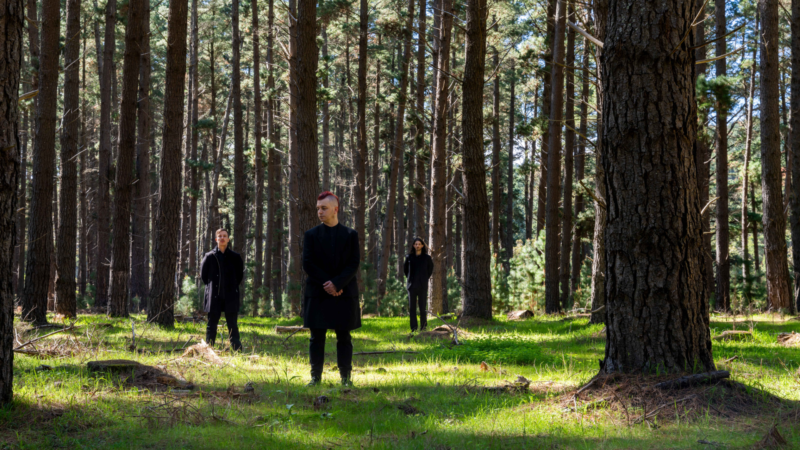

What happens when an album decides it wants to be more than an album? In the case of The Only Objects, the answer is An Excess of Hauntings, a 10-track release that takes alternative rock, post-punk, prog, trip hop and electronics, throws in synths, samples, free-jazz saxophone, banjo and plenty of beautifully unruly noise, then builds an entire world around the result.
Released nationally on August 28, the new album from the South Australian project feels deliberately ambitious. It brings together an eclectic group of collaborators, including Wolfgang Flür, who was a member of Kraftwerk during one of the band’s most influential periods, alongside a collection of local, national and international contributors. The result is a record that seems determined to keep moving rather than settle comfortably into one particular genre.
And that makes sense when you understand what An Excess of Hauntings is really exploring.
Despite the title, this isn’t an album about ghosts in the traditional sense. Instead, The Only Objects use the idea of haunting as a way of looking at the things that refuse to completely disappear. Memories, people, places, and futures that never happened can all leave traces behind, and those lingering impressions become the emotional thread running through the record.
Bandleader Patrick Lang describes the project as a deliberate move into stranger and more ambitious territory following the band’s debut album The Nostomanic Cypher. That sense of escalation is easy to hear in the album’s adventurous approach. Rather than simply repeating what came before, An Excess of Hauntings pushes the conceptual side of The Only Objects further, creating something that feels unpredictable by design.
The music itself is constantly shifting shape. The Magnetbahn, Part II takes an expansive approach, unfolding as an evolving piece that gives the album room to stretch out. Elsewhere, Access Will Be Retained erupts into free-jazz territory, bringing a more chaotic and explosive energy into the picture.
Then there’s Isolated State, which moves into moody trip-hop territory, offering a darker and more restrained atmosphere. Stabilise, meanwhile, sounds like its title might be suggesting one thing while the music has completely different plans, pushing toward something that feels increasingly close to collapse.
That unpredictability is one of the album’s biggest strengths. You never quite know what The Only Objects are going to throw into the next musical corner, and the combination of sounds could easily become overwhelming in less confident hands. Here, however, the strange combinations feel connected by the album’s larger ideas.
Memory and disappearance keep resurfacing. So does transformation, particularly the uncomfortable gap between the future we once imagined and the reality that eventually arrived. There is something inherently human about that idea. We all carry versions of places, people and possibilities that no longer exist, and An Excess of Hauntings turns those lingering traces into an elaborate musical playground.
The physical edition takes that concept even further. Alongside the CD comes a limited-edition art book designed by longtime collaborator Jesse Miles, featuring photography from light-painter Denis Smith. Rather than functioning as a traditional booklet packed with credits and lyrics, the book contains interconnected pieces of narrative that listeners are encouraged to discover and piece together.
There is no single route through the material, which means the physical release becomes its own kind of experience. You can listen to the album, explore the artwork, and gradually assemble fragments of the story in your own way. Suddenly, buying the record feels less like picking up a package and more like being handed a little mystery to solve.
That approach suits The Only Objects perfectly. An Excess of Hauntings doesn’t seem interested in giving you everything at once. It wants you to explore, get slightly lost, notice connections, and perhaps come away with a different interpretation from the person listening next to you.
The album’s mixture of styles also keeps that spirit alive. Alternative rock gives it a foundation, post-punk adds tension, prog allows the songs to evolve, trip-hop introduces atmosphere, and electronics open the door to even stranger textures. Add free-jazz saxophone, banjo, samples, synths and walls of collapsing noise, and you’ve got a record that refuses to behave like a conventional genre exercise.
Ultimately, An Excess of Hauntings feels like The Only Objects taking the idea behind their music and expanding it in every possible direction. The songs are adventurous, the collaborators add unexpected colours, and the physical release turns the whole thing into an artistic puzzle.
It may not be an album that wants to hold your hand, but that’s exactly the fun of it. An Excess of Hauntings invites you to step inside, follow the strange sounds, chase the fragments, and see what remains when the music stops.
And if something from the record keeps following you afterwards, well, perhaps that’s the point.
The Only Objects turn memory, disappearance and unrealised futures into an ambitious musical puzzle on An Excess of Hauntings